
Modern performance monitoring and automated optimization software platforms with AI are helping mining companies dramatically increase production while reducing operational costs.
by Mariana Sandin
As technology rapidly evolves, artificial intelligence (AI) has become a central focus for leaders in the mining, metals, and materials (MMM) industry. Nearly 80% of executives across industrial sectors expect AI to significantly transform operations by 2027, and early applications of generative AI (GenAI) are already improving efficiency, cutting costs, and enhancing product quality.1
This AI momentum aligns with a broader data transformation underway in mining and metals. Historically, decision-making depended on manual data collection and reconciliation among multiple sites. These are time-consuming and error-prone procedures, and they often make analyses difficult to validate, putting multimillion-dollar decisions at risk.
This challenge is further compounded by a shortage of experienced engineers and metallurgists, as many in the industrial workforce approach retirement or move to other industries. This is making expertise retention more difficult and increasing the need for efficient knowledge transfer methods to help organizations maintain productivity.
To address these and other challenges, mining companies are increasingly deploying intelligent systems that automate the collection, cleansing, and contextualization of data. By integrating live data from process historians, data lakes, ERP, and MES platforms, advanced analytics and AI solutions provide near real-time insights that empower engineers and operators to make faster and better-informed decisions, and to drive measurable business impact.
The impact on mining, metals
Global Market Insights predicts that GenAI will expand at a compound annual growth rate of 24.3% between 2025 and 2034.2 The technology’s greatest potential lies in reducing operational costs by 20% and increasing workforce productivity by more than 70%. The study proposes that optimizing raw material and energy use will account for 40% of the projected cost savings, with another 40% derived from logistics and material movement improvement, and the final 20% from enhancing product quality. These projections underscore how AI will unlock significant efficiencies and reshape industrial operations, particularly in the mining and metals sector.
According to Deloitte, most organizations remain focused on tactical outcomes, such as productivity gains (56%) and cost reductions (35%), with only 29% applying AI for strategic purposes like research and development.1 As analytics, AI, and machine learning continue to advance within MMM, subject matter experts (SMEs) will increasingly depend on AI-driven insight and data sophistication to solve complex operational challenges.
Analytics solutions
Mining companies can use advanced analytics, AI, and enterprise monitoring platforms to turn massive volumes of raw data into insights, supporting everything from simple to highly complex analyses. These platforms combine automation with intuitive interfaces for descriptive, diagnostic, predictive, and prescriptive analytics, empowering users to evaluate the results of their analyses, spot errors and successes, and optimize operations.
These platforms also enhance SME effectiveness, whether on-site or distributed globally, by providing built-in reporting and insight-sharing tools that support collaboration and knowledge exchange across locations.
Automated analyses can predict common failure modes, such as SAG mill shell wear, supporting insight sharing across sites that can be used to train new personnel. This not only prevents costly downtime but also strengthens operational resilience, ensuring more efficient and reliable operations.
Knowledge capture
Many mill product suppliers are exploring ways to integrate GenAI into their enterprise analytics solutions, making these innovative capabilities accessible to both current and future users. The adoption of large language models (LLMs), which comprise the foundation of GenAI, has accelerated implementation speeds by up to eight times, according to early adopters.
In one case, a supplier is leveraging an LLM to capture and embed expert knowledge into its operational data. With a significant portion of its SMEs set to retire within the next two years, many of the supplier’s facilities risk losing critical on-site expertise. These SMEs have historically been responsible for identifying process deviations and performing root-cause analyses on abnormal operating conditions.
By training LLMs in domain-specific language and reasoning, the supplier’s GenAI system can now respond to questions such as, “What is wrong with my continuous casting?” The advanced analytics and AI platform analyzes relevant operational data to deliver context-aware insights.
Other manufacturers are taking a more measured approach, selecting specific signals and focusing on particular process phases for analysis. In these cases, the AI assistant within the advanced analytics platform is designed to identify and explain known relationships between signals across different operational modes, such as idle or active states. After the initial inquiry, SMEs can ask follow-up questions to further refine process performance, enhance asset efficiency, reduce energy use, minimize chemical consumption, and extend equipment lifespan.
Over time, this approach stimulates LLM evolution into a prescriptive tool capable of continuously improving production based on operating conditions, material composition, and desired product quality.
Increasing water recovery
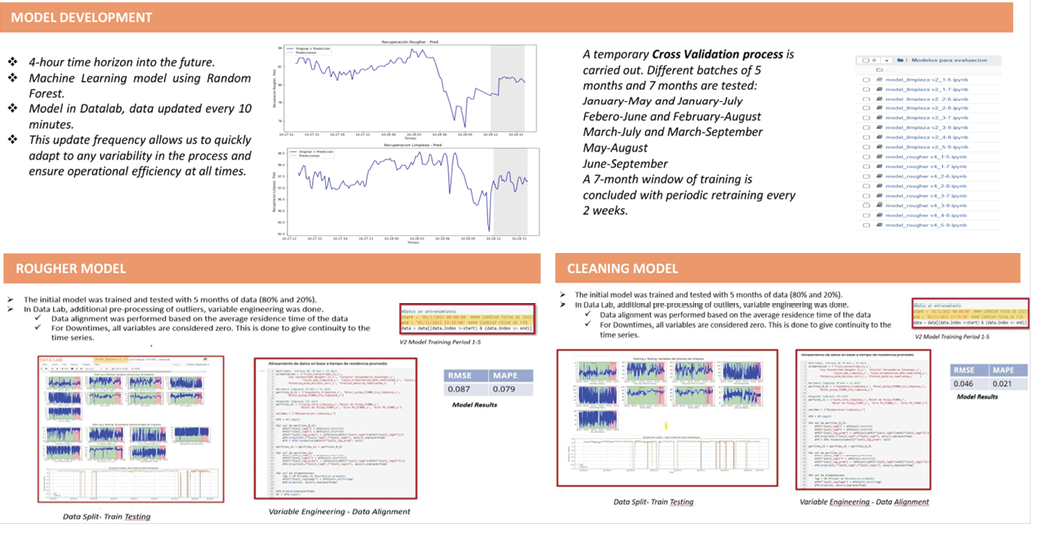
A copper concentration plant in South America used Seeq – an advanced analytics, AI, and enterprise monitoring platform – with gradient boosting machine learning (ML) to sustain an increase in solids and water recovery by 1.5%.
The improvement began with a detailed assessment and contextualization of process data using the platform. Signal preprocessing included correlation validation, dependent variable selection, and simple regression modeling to confirm technical feasibility. Once baseline metrics were established, the team implemented a more advanced XGBoost model (Figure 1).
This model predicted the percentage of solids in tailings thickener discharge based on variables such as grinding speed, treatment, granularity, hydrocyclone pressure, and feed mineralogy. Because the solids percentage directly impacts water recovery, the model’s two-hour predictive lead time empowered operators to prevent destabilizing events and improve separation efficiency.
The platform also analyzed grinding speeds, and the XGBoost model helped the team identify controllable variables to stabilize operations, which reduced freshwater use in the grinding process. This is a strong example of how plant optimization can drive both operational efficiency and sustainability through improved water reutilization.
Automate workflows to improve efficiency
With a shrinking workforce and growing operational demands, the mining industry is increasingly relying on intelligent systems to collect, cleanse, and analyze data for sustained process optimization. Manual data wrangling drains valuable SME time that could otherwise drive improvement.
Modern advanced analytics, AI, and enterprise monitoring platforms solve this challenge by automating analyses, simplifying insight sharing, and enabling enterprise-wide asset management. These capabilities foster collaboration, reduce downtime, and lower operating costs, helping miners remain competitive in a fast-evolving digital era.
By thoughtfully integrating GenAI with advanced analytics, mining companies are achieving greater efficiency, accuracy, and innovation to strengthen performance and resilience for the future.

References
[1] https://www.deloitte.com/content/dam/assets-zone3/us/en/docs/services/consulting/2024/us-state-of-gen-ai-report.pdf
[2] https://www.gminsights.com/industry-analysis/generative-ai-market
[3] https://vertix.pe/uso-de-machine-learning-para-maximizar-recuperacion-de-agua-en-espesadores-de-relaves/
About the author
Mariana Sandin leads the mining, metals, and materials practice at Seeq.